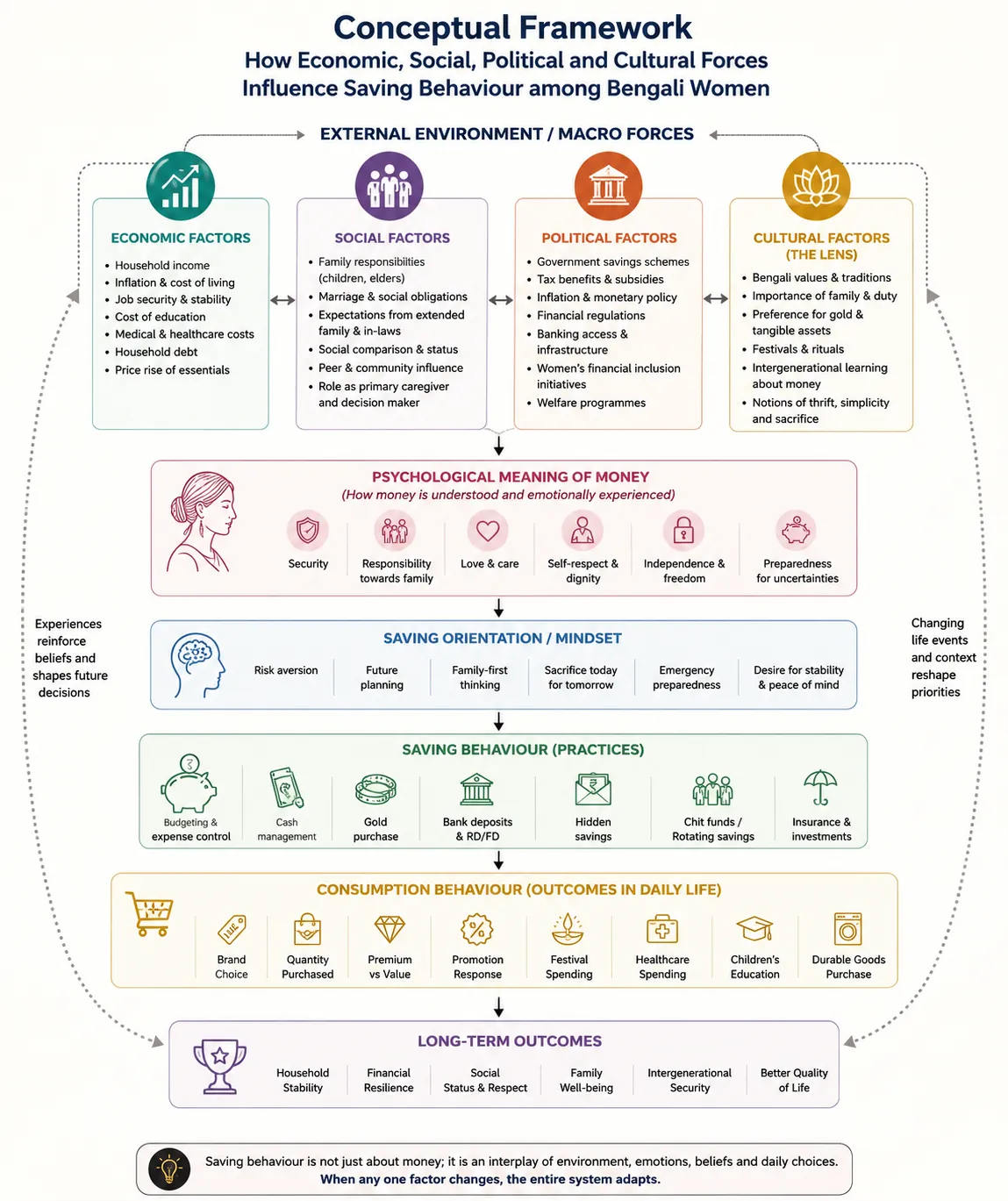
The behaviour we set out to understand
Saving behaviour varies from region to region and country to country. In West Bengal, the way Bengali women save at household level is a well-noticed pattern. Bengalis are often called “the parsimonious ones”. Whatever one makes of the label, the habits behind it are familiar in Bengali homes.
Mothers and senior women store things for future use. Beautiful crockery is “stored”, preserved for later rather than used today. Newly bought things are used less now and kept for the future — an age-old habit in Bengali households. Women stay attached to old furniture and clothes, holding on to them rather than selling them off.
Starting from these everyday observations, we set out to understand how women save, what this age-old habit does to consumption and spending, and what else follows from it.
The lens: saving is learnt
We took our starting point from the social learning theory of psychologist Albert Bandura. Bandura argued that people learn their behaviours and attitudes by watching the significant people in their lives. This learning by observation is called modelling.
Spending can be understood the same way. How we behave as consumers is learnt from parents, family members, peers, the mass media and other people who influence us, and it can be passed down from one generation to the next. Because these attitudes are learnt socially, what people learn about money and how to handle it can differ by gender.
We studied this through ethnography and in-depth interviews.
What saving means: “not now”
One insight from the study:
Saving in this region is often not experienced as the act of accumulating money, but as the repeated act of saying “not now” to oneself.
Seen through social learning theory, it is also learnt. People often learn to save from their families. We found six characteristics of saving, and each is learnt through the people and influences around them.
1. Saving is delayed gratification
The ability to put off today’s pleasure for tomorrow’s benefit.
A woman sees a ₹2,500 saree she loves. She tells herself, “Pujo is still three months away. If I don’t buy this today, I can use the money for my daughter’s coaching class.” She feels the desire, yet chooses not to satisfy it. To the women we studied, that is saving.
2. Saving is future orientation
People mentally live in the future. Instead of asking “Can I afford this?”, they ask “What if something happens next month?”
Every month, a woman keeps ₹5,000 untouched because “What if Baba falls sick?” Nothing has happened. Yet what she imagines about the future shapes what she spends today.
3. Saving is sacrifice
This sacrifice comes in two forms: purposeful and invisible.
Purposeful sacrifice. People consciously give up something they want and call that choice saving. A working woman who loves jewellery may choose not to buy gold earrings and put the money into a recurring deposit instead. She later says, “Jewellery can wait.” Saving, in this sense, is not simply the absence of spending. It is the decision to replace an immediate desire with a future goal.
Invisible sacrifice. Over time, participants may stop seeing self-denial as sacrifice at all. A homemaker who has not bought expensive clothes for herself in ten years may say, “I don’t really need anything.” Observe her further, and she continues to spend generously on others. Years of habit have made her self-denial feel normal.
4. Saving is resource optimisation
Saving doesn’t always mean spending less. Sometimes it means getting the maximum value out of what you spend. These are all saving behaviours we came across:
- Buying vegetables before the market closes, or visiting the local market late in the morning, when vendors are willing to sell at a lower price
- Waiting for festival discounts to buy clothes
- Comparing prices across three stores before buying clothes
- Using cashback apps
- Buying refill packs
- Buying larger family packs, with the satisfaction of getting more by spending less
5. Saving is precaution
Saving against uncertainty. Even though a husband and wife both have stable jobs, they keep six months’ expenses in fixed deposits. Asked why, they say, “You never know.” Fear becomes the driver of saving.
6. Saving is self-denial and putting family first
Personal desires are often placed below the needs of the family. A woman may postpone her dental treatment and use that money to pay for her daughter’s dance classes. She does not think, “I have sacrificed.” Instead, she thinks, “My child’s needs are more important than mine because I am a mother.” This is saving shaped by culture, where care for the family becomes a reason to deny the self.
Mrs. Sen’s refrigerator
One participant, Mrs. Sen, is 48 years old. Her refrigerator is 15 years old, and the door doesn’t close properly. Her daughter says, “Let’s replace the refrigerator.”
Mrs. Sen replies, “It still works.”
Six months later, researchers observed her paying ₹80,000 for her son’s MBA coaching. When asked, she says, “The fridge can wait. His future cannot.”
This single incident reveals:
- delayed gratification
- family-first orientation
- future planning
- sacrifice
- the emotional meaning of money
- consumption priorities
What it adds up to
Across these stories, the same threads run through saving behaviour among these women: delayed gratification, family-first orientation, future planning and sacrifice. In the women’s own telling, all of them are learnt. The social roles they play in their lives, and the influences around them — including the mass media — taught them to save this way.